Local children are returning to school this week after the long summer holiday break. As I told you in an earlier post, in 1944 we were living in Clayfield, Brisbane, and I finished my primary schooling when I passed the State Scholarship public examination at the end of 1944 at Eagle Junction School.
At the beginning of 1945 I started at Clayfield College in the Sub-Junior Form.
However, before I tell you about my time there I will update the information I have about our time in Amiens . I now have copies of documents from the State archives...thanks to my brother Alan and his son Steven. These include one of the purchase of the Government lease by my mother in 1943 and confirmation that it is indeed the very property as I thought. I also have a copy showing when she sold it later in 1948 and to whom. As we left the property in April 1943 and Giulio Crema took up residence in 1946 according to his daughter, we do not know who, if anyone, lived in the house during that gap in time. We think she probably took over a share-farming arrangement which the previous owner had had with a neighbouring property . I dont remember any mention of the farm after 1943 but one has to remember that in those days financial matters etc were not discussed " in front of the children."
Perhaps we will one day learn more but at the moment I am happy that I have confirmed that it was "our" property I had visited and to have met and talked with the present owners.
In early 1945 we were living at Clayfield, I started at Clayfield College, Lois continued at Eagle Junction school and Alan was at the Brisbane Grammar School.
We lived opposite the back entrance to the Clayfield college ( now the main front entrance) so it was an easy matter to simply walk across the road. This school went right from Kindergarten to Matriculation so there was a mix of Scholarship girls and "Clayfield" girls in my class. Fortunately we newcomers were quickly absorbed into the group. It was not a large school so there were only about 20 in my Form which was the only Sub-Junior form.
Secondary schooling in Queensland at that time was for 4 years ...Sub-Junior, Junior, Sub-Senior and Senior. At some schools many students left after the Junior public examination but at my school I think only one student left, the rest of us continuing until the end of the Senior year. It was an "Academic" school with no commercial or domestic subjects taught and as I have indicated an all-girls school.
I was still attending ballet classes in the city and now started Speech & Drama at the school. I continued the Speech & Drama after I finished schooling and eventually gained my ATCL (Assoc of the Trinity College London) teachers Diploma and the Australian equivalent from the AMEB. I enjoyed being in the school plays.
The war in Europe finished in April 1945 and in the Pacific in August 1945 but rationing was in full force for several more years. Many goods were either restricted to certain priorities or simply unavailable. I remember being lined up with others on the school veranda to be measured by the Head Mistress. If you were over a certain height you qualified for extra clothing coupons. I was eligible but there wasn't much to use them on!
I remember having to have a white dress for School Speech Night. I didn't have one and we couldn't find fabric anywhere in Brisbane to make one. Eventually my auntie Agnes (Tarbit) found some in a small shop in Ipswich and sent it to me. I remember making the dress. All our clothes were homemade,including our uniforms. I knitted my own school jumper for winter though I did have a bought school blazer.; I dont remember having any bought clothing until I was a working girl and even then most of my clothing I made myself.
As well as the shortage of fabric there was difficulty in buying buttons etc. Elastic was a particular problem and many a schoolgirl had buttons on the side of her homemade "bloomers". The buttons were of whatever type and colour a mother could find in her treasured pre-war stash.Often the elastic was of poor quality and prone to snap so I think we all had a safety pin in our bags ...just in case it snapped at an inconvenient time!
In mid-1945 we moved from Clayfield to Petrie which is just north of Brisbane. I dont know why we moved though I think Mum had not been very well. I had on a number of occasions had to stay home from school and was eventually called to the Principal's office to discuss the absences. I had to explain that my mother ran a guest house and my help was need if she was unwell. I was asked if there were no family aunt or other member to help. There must have been some staff so I cant think now why I had to be home to help.
It was lovely at Petrie to have our home to ourselves again. The main drawback was that we were now a long way from our school friends. Lois now started at Clayfield College and as she was there right through to matriculation she became one of the "Clayfield" girls.
We had to travel by train from Petrie to Eagle Junction station and then walk to school from there. Most week day mornings one could have seen Dad , in full suit etc, and we three schoolkids in full uniform ( Hat etc) racing down the road and through a paddock with 2 barb-wire fences to negotiate to get to the station in time!
Rules regarding school uniform were very strict but on very hot summer days we were allowed to roll down our black stockings. As I had a rush in the afternoons to catch the train home I was often spending the last few minutes of class trying to pull up those stockings without being in trouble with the teacher.
I dont have any school photos from 1945 but these were taken in 1946...
This is the house at Petrie...from the front
from the back
front garden...
I dont have any memories of making any friends in Petrie. Lois and I started learning the piano from a local woman. For me these ceased when we later moved . Lois then continued with lessons at school. Clayfield College had and still has an excellent record in Art, Music, and Speech.
My memories of the four years from the beginning of 1945 to the beginning of 1949 are very disjointed so I must ask you to forgive an octogenarian if from now on this record seems to jump around a bit!
I offer the "stories" on this site to my children and grandchildren in the hope that they will find something of interest to pass on to the next generation.Instead of just sitting in a rocking chair with my knitting or a good book, I am here at the laptop calling up old memories of a child born during the Great Depression of the 1930s then growing up during World war 11. I hope you will follow me down memory lane. I'll be keen to read your comments.
Monday, 23 January 2012
Wednesday, 4 January 2012
Amiens revisited
As I mentioned in August 2011 I was hoping to take a trip up to Amiens for a look-around. In November I contacted the school and made an appointment to have a look over the school. At the same time I made a booking to stay at a B&B farmstay in Amiens and noted that its position seemed close to where I remembered our house and orchard being.
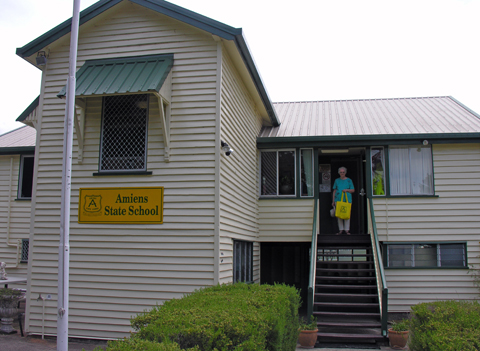
I had a lovely time at the school. the Principal gave us an hour of her time and showed us over the whole complex. It has certainly grown since my time though as you can see in the photos the oiginal building is still there though with some alteration.
Hilary goes back to school November,2011
After inspecting the campus we were taken into someof the classrooms, where we were introduced and the children had the opportunity to ask me questions about school in 1942. This was a great experience and one I enjoyed and appreciated.
When I asked the Principal if she could tell me where some of the buildings I remembered might be including the old railway station she rang a local man and arranged for us to call on him. He was a very pleasant and helpful young man and took us in his truck for a ride along the track where the railway lines used to be. The line was closed in 1974, and the rail lines removed as was the station building. He also pointed out where the bakery, saddlery and other buildings I remembered had once been. So sad to find no trace of most of them.
![]() |
![]() |
| remains of railway sheds |
![]() |
| old bakery |
![]() |
| Teachers residence ( now the Principal's residence) This much the same as in 1942. |
![]() |
| Bush nurses building, now a private residence 2011 |
Thursday, 8 December 2011
more trivia
It's been a while since my last blog and it is now nearly Christmas and I wonder where the year has gone. As I said earlier ( well I think I did!) this was not meant to be a chronological record of my life but rather a mixture of record, memories and reminiscence.
So here is today's memory!
I have just stacked the dishwasher and washed by hand the pots. How easy it all seems; hot water on tap, place powder or tablet in the dishwasher; liquid detergent in a stainless steel sink. None of those things were available when I was young.
Instead of the liquid detergent we used a soap shaker which was a small wire box with hinged lid and a long wire handle. Into the box went bits of laundry soap. With the lid closed we then swished the gadget back and forth in the hot water ( either from a kettle on the stove or later from the electric jug) hoping to raise a few bubbles.
(google images)
Next time your visiting a museum if you see a strange wire box with handle you can say "Gee my Mum/Grandma talked about using one of those!
So here is today's memory!
I have just stacked the dishwasher and washed by hand the pots. How easy it all seems; hot water on tap, place powder or tablet in the dishwasher; liquid detergent in a stainless steel sink. None of those things were available when I was young.
Instead of the liquid detergent we used a soap shaker which was a small wire box with hinged lid and a long wire handle. Into the box went bits of laundry soap. With the lid closed we then swished the gadget back and forth in the hot water ( either from a kettle on the stove or later from the electric jug) hoping to raise a few bubbles.
(google images)
Next time your visiting a museum if you see a strange wire box with handle you can say "Gee my Mum/Grandma talked about using one of those!
Thursday, 6 October 2011
Clayfield
After 6 months back at Annerley we moved to Clayfield and at the beginning of 1944 Lois and I started school at Eagle Junction State School while Alan continued at Brisbane Boys Grammar
Unfortunately I have no photo of the house at Clayfield and only vague impressions of it. I remember that it was a large Queenslander type of house and think with high steps in the front and low at the back. I have no idea of the rooms and cant even remember where the family rooms were placed and what they were like. My only clear memory is of the tennis court. We spent a lot of our spare time on that .
I dont remember how many boarders we had though I think the couple who were with us at Annerley came with us and there may have been other American service couples. I remember one elderly lady because she gave me a small elephant. She had lived in India before the war.
I understand that this house no longer exists. It was opposite what is now the front entrance , but in our time was the back entrance, to Clayfield College ; images show what appears to be a block of units where our house was.
Rationing was in full force so I dont know how Mum managed that. We did receive some extra supplies from the servicemen.
I have only a few memories from Eagle Junction school. That was my final year of Primary school which was grade 7 and the Scholarship year. Passing the public Scholarship examination allowed one to continue to secondary (high) school. Leaving age was 14 and as many would have been 13 when the exam was held I'm not sure but think anyone not going on to secondary must have had to return to Grade 7 until their 14th birthday.
I actually remember sitting for this exam because of Geography!. As I have said this was not one of my favourite subjects and I had no skill at drawing the maps. That year was the first year that the exam paper did not require the student to draw a map! How lucky can one be!
Another memory of this school is that it was the first time I was in a class where the boys sat on one side of the room and the girls on the other.I dont know if this was just at this school or if it was the policy for Grade 7 everywhere. Previously we had been seated according to the results of tests with the higher scores at the back and lowest at the front of the classroom. I was usually in the middle somewhere! The main reason i remember this segregation of boys and girls is that for one morning each week ..or it may have been all day I'm not sure...I had to go over to the boys' side. I dont remember if I was the only girl but I do remember the boys seated behind me used to have "fun" poking me and generally making me uncomfortable. This school did do domestic science but as I had not completed the syllabus after the transfer to Yeronga school from Amiens I was not allowed to do it for Scholarship. I had to stay with the boys! This ultimately was to my advantage as we did not only extra Geography which allowed me to catch up but also extra arithmetic. We also did some basic science but as we seemed to cover things like pouring water into buckets with holes or trying to work out how long it took to fill a bath etc I was left with absolutely no interst whatever in pursuing science in seconday school.
We were encouraged to take part in various activities as part of the "war effort." One of these was writing to servicemen overseas. I remember writing to my Uncle Bill (Wain) who was in England with the RAAF and also to my cousin Keith (Flitcroft) who was also with the RAAF stationed in England.
A few of the girls in the class organised a little "library" by bringing in books from home and then paying a penny to borrow a book from the "library.' The collected money was given to the 'war effort." I had always received a book from Grandfather Tarbit at Christmas and birthdays and had a good collection including some of the Girls Own albums. I didn't ever get my books back. I suspect I was too shy to go and ask for them at the end of the year . The albums would now be collector's items and I wonder where they are.
We also knitted small items such as scarves and caps which were sent to servicemen overseas.
I was able to resume my ballet lessons and do the exam that year. Strangely I do not remember missing my friends from Annerley. I dont remember any of my classmates from this year at Eagle Junction school but must have been content there.
![]() |
| Hilary(13yrs) & Lois (7yrs) , Clayfield ,1944 |
Unfortunately I have no photo of the house at Clayfield and only vague impressions of it. I remember that it was a large Queenslander type of house and think with high steps in the front and low at the back. I have no idea of the rooms and cant even remember where the family rooms were placed and what they were like. My only clear memory is of the tennis court. We spent a lot of our spare time on that .
I dont remember how many boarders we had though I think the couple who were with us at Annerley came with us and there may have been other American service couples. I remember one elderly lady because she gave me a small elephant. She had lived in India before the war.
I understand that this house no longer exists. It was opposite what is now the front entrance , but in our time was the back entrance, to Clayfield College ; images show what appears to be a block of units where our house was.
Rationing was in full force so I dont know how Mum managed that. We did receive some extra supplies from the servicemen.
I have only a few memories from Eagle Junction school. That was my final year of Primary school which was grade 7 and the Scholarship year. Passing the public Scholarship examination allowed one to continue to secondary (high) school. Leaving age was 14 and as many would have been 13 when the exam was held I'm not sure but think anyone not going on to secondary must have had to return to Grade 7 until their 14th birthday.
I actually remember sitting for this exam because of Geography!. As I have said this was not one of my favourite subjects and I had no skill at drawing the maps. That year was the first year that the exam paper did not require the student to draw a map! How lucky can one be!
Another memory of this school is that it was the first time I was in a class where the boys sat on one side of the room and the girls on the other.I dont know if this was just at this school or if it was the policy for Grade 7 everywhere. Previously we had been seated according to the results of tests with the higher scores at the back and lowest at the front of the classroom. I was usually in the middle somewhere! The main reason i remember this segregation of boys and girls is that for one morning each week ..or it may have been all day I'm not sure...I had to go over to the boys' side. I dont remember if I was the only girl but I do remember the boys seated behind me used to have "fun" poking me and generally making me uncomfortable. This school did do domestic science but as I had not completed the syllabus after the transfer to Yeronga school from Amiens I was not allowed to do it for Scholarship. I had to stay with the boys! This ultimately was to my advantage as we did not only extra Geography which allowed me to catch up but also extra arithmetic. We also did some basic science but as we seemed to cover things like pouring water into buckets with holes or trying to work out how long it took to fill a bath etc I was left with absolutely no interst whatever in pursuing science in seconday school.
We were encouraged to take part in various activities as part of the "war effort." One of these was writing to servicemen overseas. I remember writing to my Uncle Bill (Wain) who was in England with the RAAF and also to my cousin Keith (Flitcroft) who was also with the RAAF stationed in England.
A few of the girls in the class organised a little "library" by bringing in books from home and then paying a penny to borrow a book from the "library.' The collected money was given to the 'war effort." I had always received a book from Grandfather Tarbit at Christmas and birthdays and had a good collection including some of the Girls Own albums. I didn't ever get my books back. I suspect I was too shy to go and ask for them at the end of the year . The albums would now be collector's items and I wonder where they are.
We also knitted small items such as scarves and caps which were sent to servicemen overseas.
I was able to resume my ballet lessons and do the exam that year. Strangely I do not remember missing my friends from Annerley. I dont remember any of my classmates from this year at Eagle Junction school but must have been content there.
Labels:
"Eagle Junction School",
"war effort",
ballet,
Clayfield,
dancing,
houses,
memories
Thursday, 15 September 2011
Mother's Little Helper...and various chores
![]() |
| Cleaning shoes at Dutton Park. |
Chores and helping in the house were taken for granted in my generation. There was no talk of payment ; it was part of family life. I cant actually remember receiving pocket money at any age but cant be sure of that.
After finishing school and starting work in 1949 it was my job to do the family wash each weekend. No automatic washing machine or a hot water system. The water was boiled in a copper and then bucketed into the machine.Ours was a single washer with rollers on top...I still used a similar machine when we came to Toowoomba in 1966.
![]() |
| Wash day at Bald Hills |
But others will probably be very different. For example I dont expect many children today would have to empty the chamber pots! These were a standard nightly feature before indoor flush toilets . We took turns to empty them into a bucket which was then filled with water and put outside to be used as liquid fertiliser on the garden. True!
I've already mentioned emptying the water from under the ice chest. The kitchen table was plain wood and had to be scrubbed regularly. I actually didn't mind doing that and have always found satisfaction in giving something a good scrub. Mum would never use a mop to wash a floor; she thought that was not hygienic so Alan and I both learned to wash a floor on our hands and knees. I remember Mum visiting me years later in Cloncurry after Kathy was born and being horrifed to see me using a floor mop. I told her that they had used mops in the maternity hospital so a mop would do me!
The silverware had to polished and that usually fell to me. The cutlery was all silver then . The good silverware was not done so often but included a teapot and sugar bowl.
The wood stove had to be "blacked" regularly. I dont remember having to do that but I think the stove at Petrie had a silver finish and I had to apply that on occasion.
Mum was always a great jam and marmalade maker. She would buy in bulk at the markets so we would come home from school ...and in later years from work ... and there would be a case of rosellas or something to be prepared for the next day. If you wanted to eat it you expected to have to help with the preparations.
One last memory of chores is that I always wore an apron. My earliest memory of an apron is of one I embroidered in sewing class at Yeronga.
More memories from Annerley days
Grandfather Tarbit, Ida and Auntie Agnes used to visit us. I'm not sure how often. Agnes kept in touch with various relatives in England and Scotland. I'm not sure where she borrowed these outfits from but Alan and I had to put them on and be photographed.
You will notice that our hair is very short. A stray cat had adopted the family but it had some disease and we developed sores on our heads. I remember the treatment took a long time and involved visits to the Mater Childrens outpatients. It left me with a strong dislike of cats.
We had a great childhood at Annerley; the house being on high stumps allowed us to play all sorts of games under it no matter what the weather. I recall marking out rooms in the dirt ( it was not concreted) to play "house" with the neighbour girls and our dolls.
There were several ( 5 I think) mango trees in the yard ; Dad made a platform up the biggest one and we could climb up there and let our imaginations make it what ever we wished. It was also a great spot when the mangoes were ripe. I wasn't very good at climbing but with help loved to be up there.
Under the strawberry mango tree there was a little pond which was a favourite spot in the hot weather.
I cant remember if I was recovering from chicken pox or measles when I went with the Minogues for a couple of weeks to their beach house at Maroochydore. I was over the illness but there used to be quite a long quarantine period and it was decided as it was close to holiday time I need not return to school. I expect the Minogue children had finished ( at the catholic schools) a little before the state schools. Anyhow I had a wonderful time with them. I especially remember the white bread and jam! we didn't have white bread at our home so that seemed a "treat" to me. I remember the girls and I having 6 slices each one day and being amazed that nobody seemed to find that "naughty."
Our family holidays were usually spent at Maroochydore or Caloundra. One day we went with the Minogues to pick strawberries at a farm at nearby Bli Bli. It was a case of picking for free all you could fit in the provided pails. You could also eat as you picked! The farmer must have had a bigger crop than he could market.
Mum's sister Emmy lived at Montville which is on the range behind Maroochydore. The Harper family had a sugar cane farm and on at least one occasion we had a day with them. There were young boys about Alan's age who must have been Aunty Emmy's grandchldren. They introduced us to fishing for eels in the dam, chasing the young calves around the paddock and pulling them along by the tails...and all the other things that larrikin boys get up to on a farm! It was a great day! I wasn't too keen when the eels were cooked for a meal however. I preferred the sticks of sugar cane we chewed. The sugar cane trains on the narrow gauge were a common sight in the area. I'm not sure how old I was at the time.
Aunty Emmy was a lovely person and I was very sad years later when she died of cancer.
You will notice that our hair is very short. A stray cat had adopted the family but it had some disease and we developed sores on our heads. I remember the treatment took a long time and involved visits to the Mater Childrens outpatients. It left me with a strong dislike of cats.
We had a great childhood at Annerley; the house being on high stumps allowed us to play all sorts of games under it no matter what the weather. I recall marking out rooms in the dirt ( it was not concreted) to play "house" with the neighbour girls and our dolls.
There were several ( 5 I think) mango trees in the yard ; Dad made a platform up the biggest one and we could climb up there and let our imaginations make it what ever we wished. It was also a great spot when the mangoes were ripe. I wasn't very good at climbing but with help loved to be up there.
Under the strawberry mango tree there was a little pond which was a favourite spot in the hot weather.
I cant remember if I was recovering from chicken pox or measles when I went with the Minogues for a couple of weeks to their beach house at Maroochydore. I was over the illness but there used to be quite a long quarantine period and it was decided as it was close to holiday time I need not return to school. I expect the Minogue children had finished ( at the catholic schools) a little before the state schools. Anyhow I had a wonderful time with them. I especially remember the white bread and jam! we didn't have white bread at our home so that seemed a "treat" to me. I remember the girls and I having 6 slices each one day and being amazed that nobody seemed to find that "naughty."
Our family holidays were usually spent at Maroochydore or Caloundra. One day we went with the Minogues to pick strawberries at a farm at nearby Bli Bli. It was a case of picking for free all you could fit in the provided pails. You could also eat as you picked! The farmer must have had a bigger crop than he could market.
Mum's sister Emmy lived at Montville which is on the range behind Maroochydore. The Harper family had a sugar cane farm and on at least one occasion we had a day with them. There were young boys about Alan's age who must have been Aunty Emmy's grandchldren. They introduced us to fishing for eels in the dam, chasing the young calves around the paddock and pulling them along by the tails...and all the other things that larrikin boys get up to on a farm! It was a great day! I wasn't too keen when the eels were cooked for a meal however. I preferred the sticks of sugar cane we chewed. The sugar cane trains on the narrow gauge were a common sight in the area. I'm not sure how old I was at the time.
Aunty Emmy was a lovely person and I was very sad years later when she died of cancer.
Saturday, 3 September 2011
a short digression...a bit of trivia
A memory popped up this morning while I was putting on my shoes to go out. These shoes have a strap across the instep . It is fastened by velcro. I suddenly had a clear vision of Mum doing up some new shoes of mine. When I was very young my shoes had a strap with a buttton hole which did up on a button at the side of the shoe. When the shoes were new it was hard to get the button through the slot on the strap. Mum had a button hook which went through the hole, hooked around the button and thus made it easier to be pulled through.
I expect I am wearing such shoes in this photo.
Thursday, 1 September 2011
Back to the city
By 1943 the threat of invasion on Australia had diminished though the war was still being fought out in the Pacific regions. Alan had gone back to Brisbane and was attending Brisbane Grammar school so there was only Mum, Lois and I at the Amiens house. I cant remember anything about the actual return to Brisbane. I can recall that in preparation Mum and I were busy sun-drying apples . Someone, probably Uncle Ernie, had made a stand covered with chicken wire and we peeled and sliced the apples and spread them out on the wire to dry.
Mum had heard or read that accomodation was scarce in Brisbane especially for American service officers and their wives . As we had a fairly large house at Annerley she decided we could offer accomodation. I expect the decision to leave Amiens and return to Annerley was based on several reasons but I recall her explaining the accomodation situtation ; probably preparing me for the fact that we would be sharing the house.
Records show that Lois and I returned to Yeronga State School in May 1943. Here we were in the reverse situation to our arrival at the school in Amiens. I was behind in the syllabus and had some catching up to do. I cant be sure but I have a feeling that Geography may have been the subject I missed because I had been going to rural school in Stanthorpe. Yeronga didn't do Domestic science and I have always struggled with Geography so I am guessing that my problems with the subject started from this time.. It probably also had a lot to do with the way the syllabus was organised and the subject taught. We had to draw maps! The exercise book was similar to a botany/science book , that is with one side ruled and the opposite side blank. We ruled a grid on the blank side as a guide for drawing a map. Drawing of any kind was not one of my better skills! The other thing I remember about Geography was having to remember and being able to draw from memory on a map all the rivers ( in the correct order) around the Australian coastline.
Apart from the feeling of being "behind" the others in class I was very happy to be back with all my firends.
I think I am correct in saying that an American officer and his wife ( dont know if she was American or Australian) came to board with us. There was an occasion when Mum went back to Amiens , something to do with the farm...may even have been when she sold it... and while Dad and Alan had to cope with the laundry I was the cook. I was 12 years old! One evening the boarder came out to the kitchen and asked if everything was OK . I was cooking chops and she thought they were burning. Mum always cooked chops very thoroughly so I expect I was doing likewise!
Unfortunately my pleasure at being back home and seeing my friends was to be short-lived as by the beginning of the next school year we had left Annerley for ever.
Again I know nothing about the actual sale of the house or of the shift. I have a strong memory of an incident which is more likely to belong to this time rather than the earlier preparation for the move to Amiens. I walked into one of the bedrooms where Dad was packing boxes and found him flat out on the floor. I was very upset and went to Mum. I thought he was dead...but whether I actually said that I dont recall. She came and checked and said he was sound asleep.
Mum had heard or read that accomodation was scarce in Brisbane especially for American service officers and their wives . As we had a fairly large house at Annerley she decided we could offer accomodation. I expect the decision to leave Amiens and return to Annerley was based on several reasons but I recall her explaining the accomodation situtation ; probably preparing me for the fact that we would be sharing the house.
Records show that Lois and I returned to Yeronga State School in May 1943. Here we were in the reverse situation to our arrival at the school in Amiens. I was behind in the syllabus and had some catching up to do. I cant be sure but I have a feeling that Geography may have been the subject I missed because I had been going to rural school in Stanthorpe. Yeronga didn't do Domestic science and I have always struggled with Geography so I am guessing that my problems with the subject started from this time.. It probably also had a lot to do with the way the syllabus was organised and the subject taught. We had to draw maps! The exercise book was similar to a botany/science book , that is with one side ruled and the opposite side blank. We ruled a grid on the blank side as a guide for drawing a map. Drawing of any kind was not one of my better skills! The other thing I remember about Geography was having to remember and being able to draw from memory on a map all the rivers ( in the correct order) around the Australian coastline.
Apart from the feeling of being "behind" the others in class I was very happy to be back with all my firends.
I think I am correct in saying that an American officer and his wife ( dont know if she was American or Australian) came to board with us. There was an occasion when Mum went back to Amiens , something to do with the farm...may even have been when she sold it... and while Dad and Alan had to cope with the laundry I was the cook. I was 12 years old! One evening the boarder came out to the kitchen and asked if everything was OK . I was cooking chops and she thought they were burning. Mum always cooked chops very thoroughly so I expect I was doing likewise!
Unfortunately my pleasure at being back home and seeing my friends was to be short-lived as by the beginning of the next school year we had left Annerley for ever.
Again I know nothing about the actual sale of the house or of the shift. I have a strong memory of an incident which is more likely to belong to this time rather than the earlier preparation for the move to Amiens. I walked into one of the bedrooms where Dad was packing boxes and found him flat out on the floor. I was very upset and went to Mum. I thought he was dead...but whether I actually said that I dont recall. She came and checked and said he was sound asleep.
Monday, 15 August 2011
More about my life at Amiens
I have always been glad that I had this opportunity to experience country life. I think my later time in Cloncurry as a young wife and mother would have been more difficult if I had not had the experience of living away from the city.
It is good that I was able to see life on working farms. I have good memories of being in the packing shed at Uncle Ernie's farm and watching apples being graded, sorted and packed ready to be sent away to market. At some stage Mum purchased the farm on which we were staying and I remember our being sent to help the farm manager chip the rows of cabbages.
the farm
I dont think these are rows of cabbages..may be potatoes.
When we first arrived the orchard was very neglected but as I said earlier the trees were full of summer fruit. Later the apples came on so we always had a good supply of fresh fruit.
I remember this photo being taken. We had not been there very long and the cart was found among the farm implements. Dad was there and he told the girls to sit in the cart and Alan to pick up the shafts as if he was going to take us for a ride. I am fairly sure that the other two smaller girls are Gloria and Lynette Marshall, daughters of my cousin Edna who was with us for a short while.
I met Edna again some years ago at a family reunion in Brisbane.
Hilary with Edna Marshall at reunion in 2003
Uncle Ernie had Italian prisoners of war working on his farm. They were very fond of Ernie's little girls as they missed their own families very much. Most of them had been captured in North Africa and sent to Australia and placed in POW camps. From about 1940 Italy was no longer a major participant in the war in Europe so many were released to work on farms. If my memory is correct they had their meals with the family . They used to talk to us and tell us about their families, showing us photos. They were good workers and very friendly men. I learnt a few Italian phrases from them but the only phrase I remember is a swearing phrase taught to me by one of my Italian school friends. Mum came out to the veranda one afternoon to ask what all the giggling was about and we had to do some quick thinking as Lois and I were practising the phrase. It used to come in handy to mutter quielty ( very quietly) when I didn't want to do something.
We didn't see so much of our Auntie Ethel , one of Mum's older sisters, and Uncle Will as they were a bit further away. Uncle Will was in charge of the Forestry at Passchendale. Mum went down to Brisbane once, taking Lois with her and Alan and I went to stay with Auntie Ethel . She was very strict but was kind to us. I remember helping her in the kitchen and enjoying that. I was never confident around Uncle Will...for some reason I was not comfortable in his presence...perhaps he was just different in some way from my father.
When I went into Stanthorpe for Rural school I sometimes had to go to the shops first to buy ingredients for the cooking class or items for sewing. One of the first things we had to sew was a large wrap-around apron similar to a lab coat which we had to wear during the cooking class.. I seem to think the next may have been a pair of bloomers...an exercise in flat seams! I sometimes also had to buy a few things like cotton which Mum needed. When it was time to make a dress, I bought some white cotton voile ; the teacher decided it would be good fabric on which to learn pin tucking so I had to sew pin tucks all over the front of the bodice. Mum was not very impressed with my choice of material...probably wondered when I would ever get to wear it.
I think it was probably for Mothers Day that I bought this gift for her in Stanthorpe.
The Wandering Musician
Mum gave this back to me some years before she died and I now cherish it. I can still see my pencil "To Mum" on the back.
Friday, 12 August 2011
Meanwhile in the "real" world...
At Amiens we were happily enjoying fruit straight from the trees,vegies from Uncle Ernie's farm; riding our bikes and visiting relations; exploring the bush around the house and seeing lots of little wildflowers; going to the station on train days to watch the engine taking on water and the men loading the fruit and veges.
But in Brisbane and elsewhere in the larger towns and cities of Australia things were not so comfortable.
The northern part of Australia including Queensland was considered the most vulnerable so restrictions such as the blackout were tightly enforced.
In February 1942 the Japanese bombed Darwin, in March bombs fell on Broome in West Australia and in June that year submarines shelled Newcastle and Sydney.
Petrol rationing had started in 1940 and now in 1942 Ration books were issued for tea, sugar and clothing. Later butter and meat were also rationed. All persons over the age of 16 were issued with identity cards which had to be carried at all times.
I remember Mum making butter while we were at Amiens but whether because of a shortage or because she always was ready to learn something new I cannot say. I do remember she often said we all had to " do our bit" while there was a war. We had no electricity so no frig and also no ice so no ice-chest. How did she keep food fresh? Maybe we had a Coolgardie type safe...will have to ask Alan if he can remember.
There was a small local store and I think a bakery but I dont remember a butcher shop. I know we always had plenty to eat while at Amiens and I expect at that age I didn't take much notice of how Mum went about getting supplies.
But in Brisbane and elsewhere in the larger towns and cities of Australia things were not so comfortable.
The northern part of Australia including Queensland was considered the most vulnerable so restrictions such as the blackout were tightly enforced.
In February 1942 the Japanese bombed Darwin, in March bombs fell on Broome in West Australia and in June that year submarines shelled Newcastle and Sydney.
Petrol rationing had started in 1940 and now in 1942 Ration books were issued for tea, sugar and clothing. Later butter and meat were also rationed. All persons over the age of 16 were issued with identity cards which had to be carried at all times.
I remember Mum making butter while we were at Amiens but whether because of a shortage or because she always was ready to learn something new I cannot say. I do remember she often said we all had to " do our bit" while there was a war. We had no electricity so no frig and also no ice so no ice-chest. How did she keep food fresh? Maybe we had a Coolgardie type safe...will have to ask Alan if he can remember.
There was a small local store and I think a bakery but I dont remember a butcher shop. I know we always had plenty to eat while at Amiens and I expect at that age I didn't take much notice of how Mum went about getting supplies.
Subscribe to:
Posts (Atom)