Monday, 26 March 2012

Postscript to schooldays.

Though we didn't have school camps or major trips as schools organise today I do remember one great school outing while I was at Yeronga state primary school. It was probably pre-war so I would have been about 8. There was a steam ship named the SS Koopa which steamed from Brisbane to Redcliffe  and I think also to Moreton Island. The school may have had an annual picnic and on this occasion a family day was organised on the SS Koopa to Redcliffe. Mum made me a new outfit . I can still remember the floral material for the shorts and top. She also made a large sunbonnet to match...a sensible action as I have always burnt easily in the sun.  I grizzled all day about wearing that hat as I thought it was babyish! Ungrateful  young miss! I always had to wear a blouse under my bathing togs  and that also brought out the grizzles. I must have enjoyed the day on the whole as it is a fond memory!

Thanks to my son-in-law Brian for finding these photos for me.


I have mentioned earlier that my Grandfather Tarbit, Ida, and Auntie Agnes were very much part of our lives. Alan and I spent some wonderful school holidays staying with them at their home in Booval outside Ipswich.  In 1947 Lois and I spent some time with them..Alan would have been at work by then.

Here we are helping our Grandfather pick peaches for Ida to make jam.


At the time when I finished secondary school many girls were making their debut. These were very big occasions and were often organised by the school. Clayfield College did not sponsor these events and many girls from my year had a private "coming-out" party or supper dance. I went to several of these and finally persuaded my parents to allow me to have one. We held a supper-dance in a Hall at Clayfield and invited all my class. Some  of them brought a male friend along but there were still plenty of girls dancing together. I remember it as a very happy evening.

This was the dress I made for the occasion. The little bolero I had knitted in some sort of chenille which was very popular at the time.


When I see the photos in the newspaper these days of the "graduation" outfits the girls are wearing I think how young and unsophisticated my generation was...and  rationing on cloting is not in force in Australia today!


More schooltime memories

Although both the wars in Europe and in the Pacific ended in 1945 there were still shortages of many commodities. Rationing of sugar was lifted in 1947 and of meat and clothing in 1948 ( the year I finished high school) Tea and butter were still rationed until some time in 1950. Many other items were in short supply for many years.
At Clayfield College our school books were supplied as part of the school fees. This also  included  our exercise books. Our day pad ..for use in classes...didn't have nice crisp white paper as you would see today. It was a rather dingy beige colour and quite smooth not unlike a pale brown paper. As you will gather, paper was in short supply. Before one was issued with a new pad, the old one had to be handed in to the Principal for inspection. No waste space was allowed. We got around this by filling those spaces with bits of French vocabulary, Latin declensions etc.


It seems that most schools today take students for camps and some young people are lucky emogh to go on interstate or even overseas trips. During my time in High School we had no such opportunities. The only trip I had was to a National Fitness Camp and that was during school holidays not in term time. The camp was situated by Tallebudgera Creek near Burleigh Heads on the Gold Coast. I think the huts were ex-army huts ...they certainly were not glamorous as this photo shows.
National Fitness Camp, 1947

I am the one on the right in the dark one-piece
This was no "holiday" camp! We had exercises , sports, hiking from dawn to dusk. I remember my legs being covered with bruises from playing hockey on the sand. We had inspection of huts each day and there was a roster for peeling potatoes etc. There were children from many schools so there was quite a lot of rivalry also. No mobile phones, ipods, TV etc for us...I think we had a movie one evening but we were all so exhausted by the end of each day that nobody minded the early lights-out call.


While we lived at Petrie we often went swimming in the Petrie River which was only a short walk from home. On two occasions I organised a picnic at the river for my Clayfield College school mates. They came out on the train so for some of them that was a little adventure.  This photo was taken in front of our Petrie home when the girls came up to the house afterwards for afternnon tea.
After the picnic at Petrie in 1945
I am in the back row, sixth from the left ( with straps over the shoulders) Lois is on the right seated in front

I can see in these photos that some of us had long hair. I cant remember when the school rule was brought in but at some time we were not allowed to have our hair touching our collar. The girls got by this rule by tying their hair in bunches. This looked rather silly on most of us and I think the rule must have been quietly phased out!

Because we were a small school most of us had the opportunity to be involved with the sporting teams. I played a lot of tennis but missed out on being in the school team as practice time was before and after school. While we lived at Clayfield this was no problem but after we moved  I could not combine that and my ballet classes. I did get into the athletic team for the various ball games. The inter-school competitions were held at the Brisbane Exhibition grounds.
Also held at these grounds were the Public Examinations...Junior and Senior. It was Summer time  so always hot, dusty and most uncomfortable. I sat for the Senior exam in November or December of 1948 . Fortunately I passed and matriculated for University...more of that later.

In my last year I was a prefect and Head of my House...do schools still have these?


I'm on the back, left end


I  had passed all the grades in the ballet exams and this year also passed the Elementary; which unlike its title is  actually the first of the  major exams and I was then admitted as a Member of the Royal Academy of Dancing (London.) I dont think this examination is still held but there is an Australian equivalent. Will try to check that out sometime just to satisfy my own curiosity.

Between the time school finished and the end of the year, I was not allowed to sit at home and rest on my laurels. I was sent out to work straight away!  Dad arranged for me to work as a temp at the Clayfield Post Office .I had to empty the mailbox in front of the P.O. The letters all had to be hand-stamped with the Clayfield Post Office date stamp. All very exciting...no, boring! In the afternoon I had to take the mail bags across to the Railway Station before I went home. I didn't really mind this and probably would have been bored stiff at home all day. No distractions as young people have today. I think we had by now moved again , this time to Bald Hills so I was again well away from my friends.


Class of 1947, I'm third from left in back row
Some of the 1948 class
I'm back- right

Some people cant wait for the day when they finish school but I must say that I was never unhappy at school and have only good memories of that part of my life.


Wednesday, 14 March 2012

On the move again

I'm not sure how long we lived at Petrie  but at some stage Mum must have decided to go back into business and we moved to a Guest House in South Brisbane. This building has since burnt down and the property now forms part of the Mater Hospital's Medical facilities.
Lois and I were still attending Clayfield College but instead of racing to catch a train we were now racing to catch the tram. Fortunately we could catch a tram which went through to Clayfield but we had to be sure to be there for the right one. They came at regular intervals.

Drumborisk Guest House

Kathy has commented in the last post on the length of my uniform. As I mentioned earlier the school was very strict about the uniform . As I remember, the regulation length was determined this way...you knelt on the floor keeping your back straight and torso erect. The hem of your uniform had to just touch the floor in front of your knees...no shorter or longer was acceptable. Remember too that fabric and clothing was still rationed .

I dont know when we moved again ...or why...but after a brief stay in New Farm we moved to Wavell Heights.
Wavell Heights house 1948


 Now Lois and I could ride our bikes to school. I had two routes I could take.  If I rode part of the way home with a friend I would  follow a tram-line at one point. It was always wise to be careful not to let one's bike wheel get stuck in the tram rails. One day I was carefully watching that when a dog ran out at me and I remember getting both me and the bike in quite a tangle. I was of course  in full uniform, including the hat, gloves and long black stockings. I ended up  a hole in one of the stockings where the dog had taken a bit out of me...nothing drastic fortunately but all rather frightening ; fortunately I hadn't fallen off the bike.

Those black stockings were the bane of our lives. They were in short supply so had to last as long as possible. As well as mending them we had to try to keep them regulation black. This was quite impossible as the dye was certainly not colourfast and the stockings quickly became a dingy gray , sometimes with a green tinge! We all regularly dyed them with  black tea. I dont remember when rationing of tea ceased but I do remember Mum keeping all the used cold tea from the pot so I could dye those wretched  stockings. These were of course not nylon but thick cotton lisle and very uncomfortable in hot weather. 

Monday, 23 January 2012

Starting Secondary(High) School

Local children are returning to school this week after the long summer holiday break. As I told you in an earlier post,   in 1944 we were living in Clayfield, Brisbane, and  I finished my primary schooling when I passed the State Scholarship public examination at the end of 1944 at Eagle Junction School.
At the beginning of 1945 I started at Clayfield College in the Sub-Junior Form.

However, before I tell you about my time there I will update the information I have about our time in Amiens . I now have copies of documents from the State archives...thanks to my brother Alan and his son Steven. These include one of the purchase of the Government lease by my mother in 1943 and confirmation that it is indeed the very property as I thought. I also have a copy showing  when she sold it  later in 1948 and to whom. As we left the property in April 1943 and Giulio Crema took up residence in 1946 according to his daughter, we do not know who, if anyone, lived in the house during that gap in time. We think she probably took over a share-farming arrangement which the previous owner had had with a neighbouring property .  I dont remember any mention of the farm after 1943 but one has to remember that  in those days financial matters etc were not discussed " in front of the children."
Perhaps we will one  day learn more  but at the moment I am happy that I have confirmed that it was "our" property I had visited and to have met and talked with the present owners.

In early 1945 we were  living at Clayfield, I started at Clayfield College, Lois continued at Eagle Junction school and Alan was at the Brisbane Grammar School.


 We lived opposite the back entrance to the Clayfield college  ( now the main front entrance) so it was an easy matter to simply walk across the road. This school went right from Kindergarten to Matriculation so there was a mix of Scholarship girls and "Clayfield" girls in my class.  Fortunately we newcomers were quickly absorbed into the group. It was not a large school so there were only about 20 in my Form  which was the only Sub-Junior form.
Secondary schooling in Queensland at that time was for 4 years ...Sub-Junior, Junior, Sub-Senior and Senior. At some schools many students left after the Junior public examination but at my school I think only one student left, the rest of us continuing until the end of the Senior year. It was an "Academic" school with no commercial or domestic subjects taught and as I have indicated an all-girls school.
I was still attending ballet classes in the city and now started Speech & Drama at the school. I continued the Speech & Drama after I finished schooling and eventually gained my ATCL (Assoc of the Trinity College London) teachers Diploma and the Australian equivalent from the AMEB.  I enjoyed being in the school plays.

The war in Europe finished in April 1945 and in the Pacific in August 1945 but rationing was in full force for several more years. Many goods were  either restricted to certain priorities or simply unavailable. I remember being lined up with others on the school veranda to be measured by the Head Mistress. If you were over a certain height you qualified for extra clothing coupons. I was eligible but there wasn't much to use them on!

 I remember having to have a white dress for School Speech Night. I didn't have one and we couldn't find fabric anywhere in Brisbane to make one. Eventually my auntie Agnes (Tarbit) found some in a small shop in Ipswich and sent it to me. I remember making the dress. All  our clothes were homemade,including our uniforms. I knitted my own school jumper for winter though I did have a bought school blazer.; I dont remember having any bought clothing until I was a working girl and even then most of my clothing I made myself.

As well as the shortage of fabric there was difficulty in buying buttons etc. Elastic was a particular problem and many a schoolgirl had buttons on the side of her homemade "bloomers". The buttons were of whatever type and colour a mother could find in her treasured pre-war stash.Often the elastic was of poor quality and prone to snap so I think we all had a safety pin in our bags ...just in case it snapped at an inconvenient time!

In mid-1945 we moved from Clayfield to Petrie which is just north of Brisbane. I dont know why we moved though I think Mum had not been very well. I had on a number of occasions had to stay home from school and was eventually called to the Principal's office to discuss the absences. I had to explain that my mother ran a guest house and my help was need if she was unwell. I was asked if there were no family aunt or other member to help. There must have been some staff so I cant think now why I had to be home to help.
It was lovely at Petrie to have our home to ourselves again. The main drawback was that we were now a  long way from our school friends. Lois now started at Clayfield College and as she was there right through to matriculation she became one of the "Clayfield" girls.

We had to travel by train from Petrie to Eagle Junction station and then walk to school from there. Most week day mornings one could have seen  Dad , in full suit etc, and we three schoolkids in full uniform ( Hat etc) racing down the road and through a paddock with 2 barb-wire fences to negotiate to get to the station in time!
Rules regarding school uniform were very strict but on very hot summer days we were allowed to roll down our black stockings. As I had a rush in the afternoons to catch the train home I was often spending the last few minutes of class trying to pull up those stockings without being in trouble with the teacher.

I dont have any school photos from 1945 but these were taken in 1946...


This is the house at Petrie...from the front
from the back


front garden...

I dont have any memories of making any friends in Petrie. Lois and I started learning the piano from a local woman. For me these ceased when we later moved . Lois then continued with lessons at school. Clayfield College  had and still has an excellent record in Art, Music, and Speech.

My memories of the four years from the beginning of 1945 to the beginning of 1949 are very disjointed so I must ask you to forgive an octogenarian if from now on this record  seems to jump around a bit!


Wednesday, 4 January 2012

Amiens revisited

As I mentioned in August 2011 I was hoping to take a trip up to Amiens for a look-around. In November I contacted the school and made an appointment to have a look over the school. At the same time I made a booking to stay at a B&B farmstay in Amiens and noted that its position seemed close to where I remembered our house and orchard being.

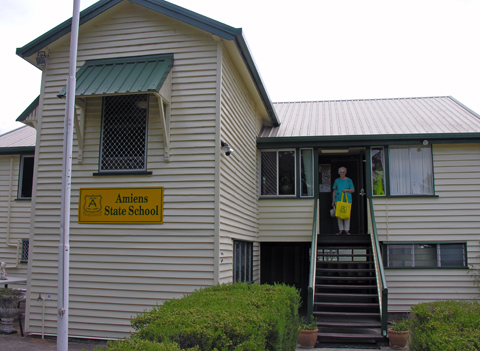
I had a lovely time at the school. the Principal gave us an hour of her time and showed us over the whole complex. It has certainly grown since my time though as you can see in the photos the oiginal building is still there though with some alteration.


Hilary goes back to school November,2011

After inspecting the campus we were taken into someof the classrooms, where we were introduced and the children had the opportunity to ask me questions about school in 1942. This was a great experience and one I enjoyed and appreciated.
When I asked the Principal if she could tell me where some of the buildings I remembered  might be  including the old railway station she rang a local man and arranged for us to call on him. He was a very pleasant and helpful young man and took us in his truck for a ride along the track where the railway lines used to be. The line was closed in 1974, and the rail lines removed as was the station building. He also pointed out where the bakery, saddlery and other buildings I remembered had once been. So sad to find no trace of most of them.


remains of railway bridge on Nuncio's property 


remains of railway sheds


old bakery


Teachers residence ( now the Principal's residence) This much the same as in 1942.


Bush nurses building, now a private residence 2011

Rural (Bush) nurses building in earlier times

After our tour of the area we headed off and had lunch at a winery before going  to the farmstay. When I saw the general position I felt it was all very familiar and became very hopeful that I had found the position of our orchard. After unpacking , I was browsing through a folder the owners had left in the cottage and found a written reference which stated that Mrs Tarbit and her children had stayed on the property in 1942-43. This was very encouraging and quite exciting. There was also mention of a family who came later and the name of someone who could perhaps give more information I have since contacted her and she confirmed that an earlier house had been in front of the present one. This house  was the one she had lived in and her brother has confirmed would have been the  one in which we lived . It was burnt down around 1970. My nephew has since found confirmation in the State Archives that my mother took over the lease in 1943 and relinquished it in 1948. This suggests that it was still Government land ( they were originally part of the post-WW1 soldier settlement) and not freehold.  Alan and Steven are still researching the area in the Archives.

Shadowbox farmstay 2011

Cottage b&b at Shadowbox farmstay

cottage ...and rocks on which I believe Lois and I used to play.
Behind those trees is a very large granite outcrop I wasn't about to walk through that long grass without boots but I am sure this was one of our play areas .
The owners of the property are a very friendly and pleasant couple . They provided us with dinner in their homestead and we found we had a number of things in common so it was an evening of interesting conversation. When I have more information concerning our time on the property I will again visit them.


Thursday, 8 December 2011

more trivia

It's been a while since my last blog and it is now nearly Christmas and I wonder where the year has gone. As I said earlier ( well I think I did!) this was not meant to be a chronological record of my life but rather a mixture of record, memories  and reminiscence.

So here is today's memory!

I have just stacked the dishwasher and washed by hand the pots. How easy it all seems; hot water on tap, place powder or tablet in the dishwasher; liquid detergent in a stainless steel sink. None of those things were available when I was young.

Instead of the liquid detergent we used a soap shaker which was a small wire box with hinged lid and a long wire handle. Into the box went bits of laundry soap. With the lid closed we then swished the gadget back and forth in the hot water ( either from a kettle on the stove or later from the electric jug) hoping to raise a few bubbles.

 (google images)
Next time your visiting a museum if you see a strange wire box with handle you can say "Gee my Mum/Grandma talked about using one of  those!

Thursday, 6 October 2011

Clayfield

After 6 months back at Annerley we moved to Clayfield and at the beginning of 1944 Lois and I started school at Eagle Junction State School while Alan continued at Brisbane Boys Grammar

Hilary(13yrs) & Lois (7yrs) , Clayfield ,1944

Unfortunately I have no photo of the house at Clayfield and only vague impressions of it. I remember that it was a large Queenslander type of house and think with high steps in the front and low at the back. I have no idea of the rooms and cant even remember where the family rooms were placed and what they were like. My only clear memory is of the tennis court. We spent a lot of our spare time on that .
I dont remember how many boarders we had though I think the couple who were with us at Annerley came with us and there may have been other American service couples.  I remember one elderly lady because she gave me a small elephant.  She had lived in India before the war.
I understand that this house no longer exists. It was opposite what is now the front entrance , but in our time was the back entrance, to Clayfield College ; images show what appears to be a block of units where our house was.

Rationing was in full force so I dont know how Mum managed that. We did receive some extra supplies from the servicemen.
I have only a few memories from Eagle Junction school. That was my final year of Primary school which was grade 7 and the Scholarship year. Passing the public Scholarship examination allowed one to continue to secondary (high) school. Leaving age was 14 and as many would have been 13 when the exam was held I'm not sure but think anyone not going on to secondary must have had to return to Grade 7 until their 14th birthday.
I actually remember sitting for this exam because of Geography!. As I have said this was not one of my favourite subjects and I had no skill at drawing the maps. That year was the first year that the exam paper did not require the student to draw a map! How lucky can one be!

Another memory of this school  is that it was the first time I was in a class where the boys sat on one side of the room and the girls on the other.I dont know if this was just at this school or if it was the policy for Grade 7 everywhere. Previously we had been seated according to the results of tests with the higher scores at the back and lowest at the front of the classroom. I was usually in the middle somewhere! The main reason i remember this segregation of boys and girls is that for one morning each week ..or it may have been all day I'm not sure...I had to go over to the boys' side. I dont remember if I was the only girl but I do remember the boys seated behind me used to have "fun" poking me and generally making me uncomfortable. This school did do domestic science but as I had not completed the syllabus after the transfer to Yeronga school from Amiens I was not allowed to do it for Scholarship. I had to stay with the boys! This ultimately was to my advantage as we did not only extra Geography which allowed me to catch up but also extra arithmetic. We also did some basic science but as we seemed to cover things like pouring water into buckets with holes or trying to work out how long it took to fill a bath etc I was left with absolutely no interst whatever in pursuing science in seconday school.

We were encouraged to take part in various activities as part of the "war effort." One of these was writing to servicemen overseas. I remember writing to my Uncle Bill (Wain) who was in England with the RAAF and also to my cousin Keith (Flitcroft) who was also with the RAAF stationed in England.
A few of the girls in the class organised a little "library" by bringing in books from home and then paying a penny  to borrow a book from the "library.' The collected money was given to the 'war effort." I had always received a book from Grandfather Tarbit at Christmas and birthdays and had a good collection including some of the Girls Own albums. I didn't ever get my books back. I suspect I was too shy to go and ask for them at the end of the year . The albums would now be collector's items and I wonder where they are.

We also knitted small items such as scarves and caps which were sent to servicemen overseas.

I was able to resume my ballet lessons  and do the exam that year. Strangely I do not remember missing my friends from Annerley. I dont remember any of my classmates from this year at Eagle Junction school but must have been content there.

Thursday, 15 September 2011

Mother's Little Helper...and various chores

Talk about starting early!

Dad has written on the back of this print " She must have thought I was a hawker." My guess is that he took me by surprise as the hallway looks rather dark and he was possibly standing against the light. I certainly look geared for action! This was at Dutton Park.


Cleaning shoes at Dutton Park.
I dont know if that is Mum or one of the cousins who stayed with us while attending College.

Chores and helping in the house were taken for granted in my generation. There was no talk of payment ; it was part of family life. I cant actually remember receiving pocket money at any age but cant be sure of that.
After finishing school and starting work in 1949 it was my job to do the family wash each weekend. No automatic washing machine or a hot water system. The water was boiled in a copper and then bucketed into the machine.Ours was a single washer with rollers on top...I still used a similar machine when we came to Toowoomba in 1966.


Wash day at Bald Hills
Many of our tasks were similar to those of children today...washing and drying dishes, making one's own bed, cleaning your school shoes...and sometimes Dad's also, cutting one's own lunch...and sometimes Dad's also. We had some fun doing the dishes at Annerley ; Alan would wash, I would dry then pass the item to young Lois who walked along a row of chairs so she could reach the "dresser" to put the things away. Not sure whose idea that was but I expect Alan thought of it.

But others will probably be very different. For example I dont expect many children today would have to empty the chamber pots! These were a standard nightly feature before indoor flush toilets . We took turns to empty them into a bucket which was then filled with water and put outside to be used as liquid fertiliser on the garden. True!

I've already mentioned emptying the water from under the ice chest. The kitchen table was plain wood and had to be scrubbed regularly. I actually didn't mind doing that and have always found satisfaction in giving something a good scrub. Mum would never use a mop to wash a floor; she thought that was not hygienic so Alan and I both learned to wash a floor on our hands and knees. I remember Mum visiting me years later in Cloncurry after Kathy was born and being horrifed to see me using a floor mop. I told her that they had used mops in the maternity hospital so a mop would do me!

The silverware had to polished and that usually fell to me. The cutlery was all silver then . The good silverware was not done so often but included a teapot and sugar bowl.

The wood stove had to be "blacked" regularly. I dont remember having to do that but I think the stove at Petrie had a silver finish and I had to apply that on occasion.

Mum was always a great jam and marmalade maker. She would buy in bulk at the markets so we would come home from school ...and in later years from work ... and there would be a case of rosellas or something to be prepared for the next day. If you wanted to eat it you expected to have to help with the preparations.

One last memory of chores is that I always wore an apron. My earliest memory of an apron is of one I embroidered in sewing class at Yeronga.

More memories from Annerley days

Grandfather Tarbit, Ida and Auntie Agnes used to visit us. I'm not sure how often. Agnes kept in touch with various relatives in England and Scotland. I'm not sure where she borrowed these outfits from but Alan and I had to put them on and be photographed.
You will notice that our hair is very short. A stray cat had adopted the family but it had some disease and we developed sores on our heads. I remember the treatment took a long time and involved visits to the Mater Childrens outpatients. It left me with a strong dislike of cats.

We had a great childhood at Annerley; the house being on high stumps allowed us to play all sorts of games under it no matter what the weather. I recall marking out rooms in the dirt ( it was not concreted) to play "house" with the neighbour girls and our dolls.
There were several ( 5 I think) mango trees in the yard ; Dad made a platform up the biggest one and we could climb up there and let our imaginations make it what ever we wished. It was also a great spot when the mangoes were ripe. I wasn't very good at climbing but with help loved to be up there.
Under the strawberry mango tree there was a little pond which was a favourite spot in the hot weather.
I cant remember if I was recovering from chicken pox or measles when I went with the Minogues for a couple of weeks to their beach house at Maroochydore. I was over the illness but there used to be quite a long quarantine period and it was decided as it was close to holiday time I need not return to school. I expect the Minogue children had finished ( at the catholic schools) a little before the state schools.  Anyhow I had a wonderful time with them. I especially remember the white bread and jam! we didn't have white bread at our home so that seemed a "treat" to me. I remember the girls and I having 6 slices each one day and being amazed that nobody seemed to find that "naughty."
Our family holidays were usually spent at Maroochydore or Caloundra. One day we went with the Minogues to pick strawberries at a farm at nearby Bli Bli. It was a case of picking for free all you could fit in the provided pails. You could also eat as you picked! The farmer must have had a bigger crop than he could market.

Mum's sister Emmy lived at Montville which is on the range behind Maroochydore. The Harper family had a sugar cane farm and on at least one occasion we had a day with them. There were young boys about Alan's age who must have been Aunty Emmy's grandchldren. They introduced us to fishing for eels in the dam, chasing the young calves around the paddock and pulling them along by the tails...and all the other things that larrikin boys get up to on a farm! It was a great day!  I wasn't too keen when the eels were cooked for a meal  however. I preferred the sticks of sugar cane we chewed. The sugar cane trains on the narrow gauge were a common sight in the area. I'm not sure how old I was at the time.
Aunty Emmy was a lovely person and I was very sad years later when she died of cancer.

Saturday, 3 September 2011

a short digression...a bit of trivia

A memory popped up this morning while I was putting on my shoes to go out. These shoes have a strap across the instep . It is fastened by velcro. I suddenly had a clear vision of Mum doing up some new shoes of mine. When I was very young my shoes  had a strap with a buttton hole which did up on a button at the side of the shoe. When the shoes were new it was hard to get the button through the slot on the strap. Mum had a button hook which went through the hole, hooked around the button and thus made it easier to be pulled through.

I expect I am wearing such shoes in this photo.